zailey
verified researcher6.093, 116.128 • 7/21/2026 • 05:46 PM
New cryptid species documentedHantu Gelap Guruh
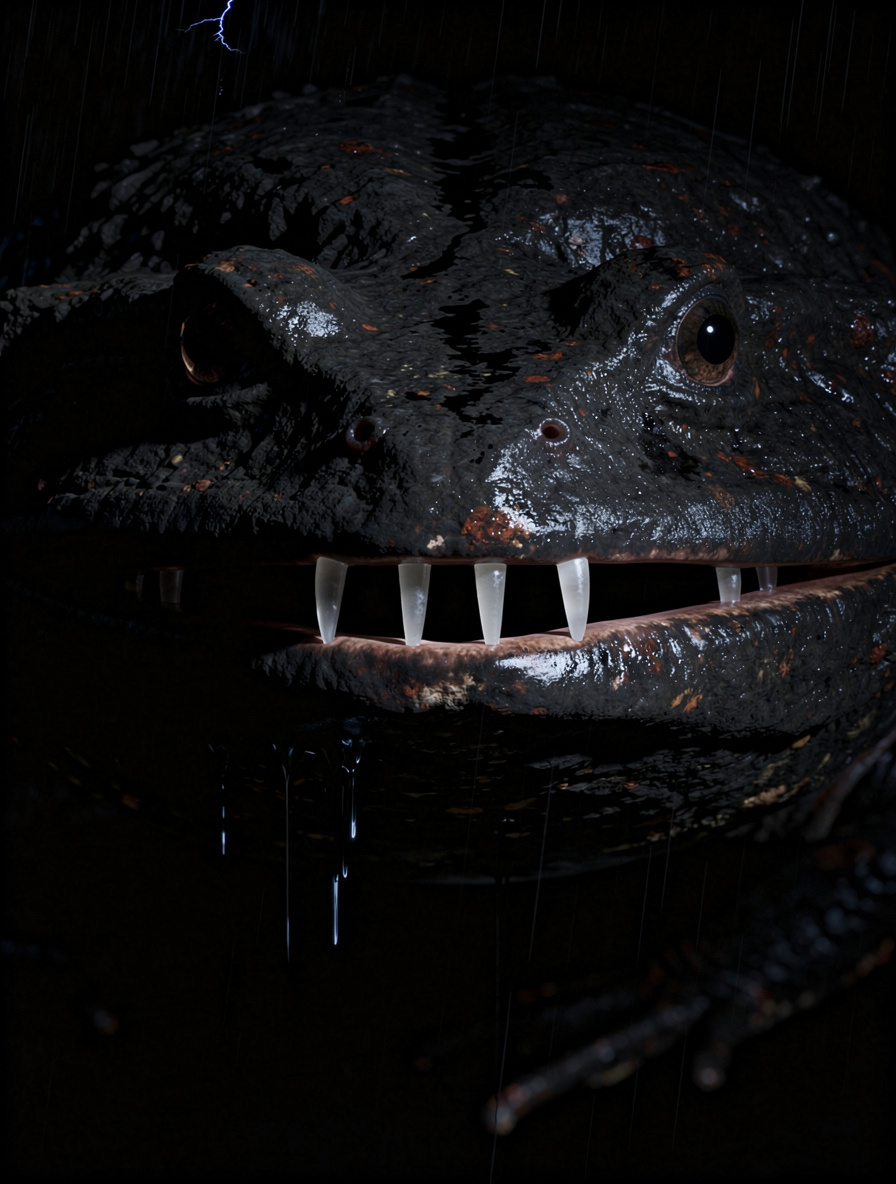
Rarity: Legendary. Tenebrana pluvimortis is perhaps the most elusive cryptid documented in Bornean cryptozoology — not because it hides, but because it *is* the darkness itself. This extraordinary amphibian, estimated at 2.5 to 4 meters in length, possesses a skin composed of densely packed melanophore-like organelles called "voidchromes" — biological structures that absorb 99.7% of visible light across all wavelengths, rivaling synthetic vantablack. The creature is functionally invisible in darkness, and even under direct illumination appears as a flat, featureless silhouette — a hole in reality. Its body plan resembles an enormously elongated giant salamander with six limbs ending in broad, suction-cupped digits, but its head is disproportionately wide and flat, housing a jaw that unhinges laterally rather than vertically, splitting its face into three mandibular sections lined with backward-curving cartilaginous teeth. T. pluvimortis is exclusively active during thunderstorms. It has evolved specialized tympanic organs along its flanks that resonate with thunder frequencies, using the sonic energy to echolocate across distances up to 800 meters — effectively "seeing" through sound that it does not produce itself. Between storms, it enters a state of profound torpor in waterlogged burrows beneath kampung houses, its metabolism dropping to near-zero. Local Kadazan-Dusun folklore speaks of the Hantu Gelap Guruh — the "dark ghost of thunder" — a spirit that steals the light from rooms during storms. Electrical failures during thunderstorms in rural Sabah villages are sometimes attributed to this creature, and there may be a scientific basis: its voidchrome skin generates a weak bioelectric field that can interfere with unshielded wiring at close range, causing localized power disruptions. Its ecological niche is that of an apex nocturnal ambush predator of wild boar, civets, and large rodents during monsoon storms. Its primary weakness is its absolute dependence on thunderstorms for navigation; in silence, it is effectively blind and immobile. The photograph — pure, impenetrable black — may represent the most direct documentation of this species ever captured: the creature filling the entire frame, its light-devouring skin rendering the camera's sensor useless.